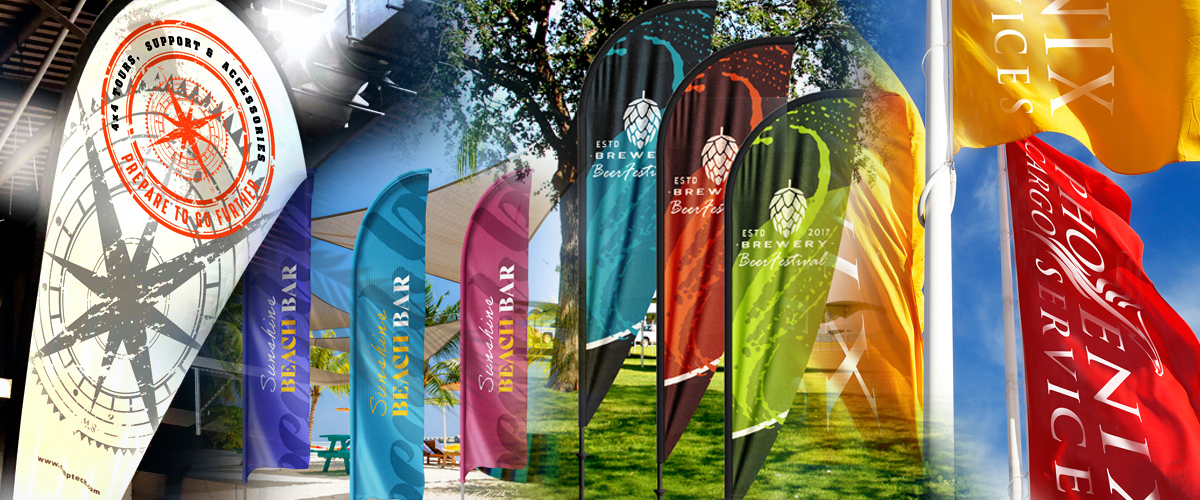
Printing on flags isn’t like printing on other textiles. By their nature, flag fabrics are lightweight and highly mobile (they’re flags, after all). Even experienced printers can find printing on flag materials tricky because the fabric construction, ink behaviour and finishing requirements aren’t quite the same as they’ll encounter anywhere else. So in this post, we’ll look at common flag fabric printing mistakes – and flag (sorry) ways of avoiding them.

What makes printing on flag fabric different?
It’s all down to the material. Unlike heavier display textiles, flag fabric materials need to balance durability, lightweight movement, colour vibrancy and (often) weather resistance, all while maintaining excellent print clarity on both sides of the fabric.
That’s a lot to juggle, which means even small production mistakes can leave you looking at blurred graphics, show-through, fading colours, fraying edges, or flags that struggle to withstand more than a gentle breeze.
So what causes these common pitfalls and how can you avoid them?

Mistake #1: Choosing the wrong flag fabric
Take a look at Soyang’s flag fabrics and you’ll see we have two choices of material: knitted and woven. Both are polyester. Both can deliver great results. But it’s important to choose the right fabric for your application.
Knitted flag fabrics are generally the softer, lighter, more flexible choice. If you want a flag that really makes the most of a breeze and offers lots of eye catching movement, this is a good choice – especially with smaller flags that aren’t intended for long-term use.
Woven flag fabrics are more dimensionally stable and durable. That makes them the wiser choice for long-term outdoor use and on larger flags, where choosing woven over knitted reduces the risk of stretching and distortion.
Woven fabrics do increase the risk of ink penetration and strike-through, so you’ll want to test the material with your inks and print system before you go into full production.
Mistake #2: Getting the heat settings wrong
If you run a print shop, you don’t need us to tell you how critical heat fixation is to dye-sublimation and transfer printing processes. Get the temperature, dwell time or pressure settings wrong and you risk damaging the fabric or the way the ink bonds to the material.
Lightweight flag fabrics are particularly sensitive to heat. Too high and you risk shrinkage, scorching or distortion. Too low and you could affect dye transfer and wash and weather resistance. The fact that lightweight knitted flag fabrics are likely to react to heat faster than heavier textiles makes things even more challenging, but there’s plenty you can do to lock in printing success:
- Follow the manufacturer recommended temperature and dwell settings
- Recalibrate your heat press to ensure you’re accurately controlling the temperature
- Test heat settings before launching into full production
- Keep an eye on fabric tension during fixation
- Lower pressure settings for lighter-wight fabrics
Mistake #3: Choosing the wrong ink type
Your choice of ink will have a big impact on flag fabric colour vibrancy, UV resistance, wash fastness, weather resistance and more. Using an incompatible ink risks poor adhesion, smudging, excessive bleeding and reduced durability.
Perhaps the biggest challenge of all as a flag printer is achieving the right balance of front-side vibrancy and reverse-side visibility. So, to help you achieve a great result every time, try the following:
- Use inks specifically formulated for polyester flag fabrics
- Ensure compatibility between ink, printer, transfer paper and fabric
- Test for UV resistance and weather durability
- Optimise ink saturation profiles for lightweight textiles
- Avoid over-inking, which can reduce sharpness and affect airflow through the flag
- Create an ICC colour profile specifically for your flag fabrics
Mistake #4: Poor fabric tension and handling
Flag fabrics – and as we’ve already seen, lightweight knitted flag fabrics in particular – are a challenge to print because they’re prone to moving and stretching. That can lead to distortion, inconsistent print and print feed issues.
But even with the lightest-weight flag materials, you can avoid telltale wrinkles, banding and distortion when you keep the fabric tension consistent during production. To help with that process, do the following:
- Use feed and take-up systems suitable for the material you’re working with
- Avoid over-stretching knitted fabrics
- Let the fabric acclimatise before printing – lightweight textiles are highly responsive to environmental changes and your fabric may expand or contract when moved from a storage area to a print room, increasing the risk of stretching or skewing
- Monitor humidity levels in the print room (for the same reasons as above)
- Train your team to recognise early signs of tension distortion (see below)
How to spot the early signs of tension distortion
The signs of tension distortion might not be obvious at first, but the quicker you pick up on the following, the quicker you can correct the tension settings and avoid waste:
- Wavy lines that are supposed to be straight
- Misaligned repeat patterns
- Compressed, tilted, ‘squashed’ or otherwise distorted typography or logos
- Edge curling
- Wrinkling
Mistake #5: Getting the finishing wrong
Even the highest-quality printing needs quality finishing to complete the job. With a weak hem, poor reinforcement or incorrect stitching, a flag that should be comfortably able to cope with everything the great outdoors throws at it can fray, tear, curl or lose its shape.
So to make sure the finishing gets the same sort of detailed attention the printing received, consider the following:
- Use reinforced stitching for high-stress areas and double stitching or reinforced webbing for large outdoor flags – and match your approach to expected wind conditions on site
- Choose thread that’s suitable for outdoor UV exposure – a standard sewing thread that would be fine indoors may not have the UV resistance to prevent it weakening outdoors, which will eventually cause seams to fail
- Heat-cut or seal edges where appropriate to prevent fraying
- Test mounting systems before you install them
Talk to Soyang
Want to give your flag the best possible chance of looking great for longer? Before you buy, talk to us.